Go to Blogger edit html and find these sentences.Now replace these sentences with your own descriptions.This theme is Bloggerized by Lasantha Bandara - Premiumbloggertemplates.com.
Go to Blogger edit html and find these sentences.Now replace these sentences with your own descriptions.This theme is Bloggerized by Lasantha Bandara - Premiumbloggertemplates.com.
Go to Blogger edit html and find these sentences.Now replace these sentences with your own descriptions.This theme is Bloggerized by Lasantha Bandara - Premiumbloggertemplates.com.
Go to Blogger edit html and find these sentences.Now replace these sentences with your own descriptions.This theme is Bloggerized by Lasantha Bandara - Premiumbloggertemplates.com.
Go to Blogger edit html and find these sentences.Now replace these sentences with your own descriptions.This theme is Bloggerized by Lasantha Bandara - Premiumbloggertemplates.com.
Sau biết bao lời
đồn đãi là Đức và Mỹ sẽ bí mật thỏa hiệp huề
để cùng dẫn nhau vào vòng 16, hai đội banh không đồng
sức này đã chiến đấu hết sức quyết liệt.
Đức tấn
công ngay từ giây phút đầu, và tuy chật vật, nhưng đội
Mỹ chống trả khá tốt, mỗi khi nguy kịch thì thủ môn
Tim Howard là vị cứu tinh bắt banh dính như cau su.
Mỹ liên tục
thoát hiểm sau 45 phút đầu, nhưng vào phút thứ55, Muller
của Đức đá một quả vào góc trước tiếng ồ thất vọng
của mọi người.
Cả phòng biên tập Người Việt, ngoài người
có trách nhiệm viết bài tường trình live, tất cả ngồi
dán mắt trước máy. Tất cả ủng hộ đội Mỹ, trừ
một người bắt Đức bị bạn bè gọi là Nazi. Với kết quả thua 1-0, Mỹ vẫn đi tiếp
vào vòng 16, nhưng chắc chắn thua không phải là dự tính của coach Klinsmann. Ông nói:
“Lọt
vào vòng 16 là bước lớn của chúng tôi, mọi người cho
rằng chúng tôi không có cơ hội thoát khỏi nhóm tử
thần, nhưng điều này đã xẩy ra, và chúng tôi thực sự
muốn đi tới.”
Từ đất tử thần, đội Mỹ đã
sống sót. Hẹn gặp đội Bỉ...
Chỉ
còn hơn 12 giờ đồng hồ nữa thôi, mọi người đang
hồi hộp chờ trận đấu kế tiếp.
Sáng mai, từ 8 giờ
sáng, giờ California, hội trường nhật báo Người Việt
sẽ chật ních những người đến chờ xem trận đấu
giữa Mỹ và Đức, bắt đầu lúc 9AM.
Mọi
người trong sở nhôn nhao hỏi nhau “ông nghĩ ai sẽ
thắng?” “ông bắt đội nào?” “Tôi
bắt đội Mỹ đó, có ai chấp gì không?”
Qua những kết quả bất ngờ vừa thấy, nhiều
người ngán không dám cá, nhiều người đoán có lẽ Mỹ/Đức sẽ ngầm thỏa thuận để huề, vì như thế “cùng có lợi
cho hai bên,” vì chỉ cần như thế là hai bên cũng đủ
để advance rồi, vì coach Klinsmann của Mỹ cũng là người Đức,
lại là thầy cũ của coach Joachim, vì tình xưa nghĩa cũ, vì tình đồng hương, vì những lý do đại loại
như thế.
Tôi thì không hình dung được cảnh đội
tuyển Hoa Kỳ sẽ đánh cầm chừng chỉ để lấy huề.
Thứ nhất điều đó không hợp với tinh thần thể thao của dân Mỹ.
Họ sẽ đánh chết bỏ, một ăn cả, ngã về không. Cứ
nhớ lại trận đấu với Bồ Đào Nha vừa rồi thì thấy,
họ đánh hết mình cho tới phút chót, bất kể điều đó
có lợi cho việc tính điểm hay không.
Thêm vào đó, trận đấu với Đức sắp tới
là cuộc đấu lịch sử. Cơ hội chỉ đến bốn năm một
lần, và với một quốc gia mà môn bóng đá đang trên đà
phát triển như Hoa Kỳ, thắng được Đức sẽ là một
bước tiến nhẩy vọt, một khúc quanh lịch sử, sẽ lập tức biến Hoa Kỳ đang từ nước "đứng ngoài cuộc chiến" thành một quốc gia mê say bóng
đá.
Không
thể phủ nhận môn soccer ngày càng được nhiều dân Mỹ
thích xem. Nghe đâu trận đấu giữa Mỹ và Ghana tuần
trước thu hút 11 triệu người xem, trận giữa Mỹ và Bồ
Đào Nha chiều Chủ Nhật khiến hơn 18 triệu người dán mắt
vào màn ảnh, chưa tính tới khoảng 7 triệu người Mỹ
theo dõi trận đấu qua Univision.
Dĩ nhiên những con
số này đang được lãnh đạo của các đài truyền hình
chăm chú theo dõi, và máy tính đang làm việc nhanh
như cắt trong những cái đầu quen tính toán.
Cũng không
phải tự dưng mà lần này dân Mỹ lại cảm thấy hứng
thú với World Cup. Trong sự hăng say cổ vũ cho đội nhà,
mọi người có vẻ đang chờ đợi một điều gì đó mà
họ kỳ vọng Klinsmann và đội ngũ trẻ của ông sẽ mang
lại, một cơ hội để bóng đá Hoa Kỳ quẹo vào một
khúc quanh lịch sử.
Vì vậy, tôi mong và vì thế
đoán ngày mai đội Mỹ sẽ thắng, 2-1 hay 1-0 không thành
vấn đề, miễn là thắng. Hà Giang June 25th, 2014
Nhiều bạn ở xa hay thậm chí ở ngay nước Mỹ mà ít theo dõi bóng đá Mỹ, lâu lâu mới "nhảy" vô một lần, nên thường có những nhận định không chính xác về bóng đá Mỹ và khán giả Mỹ. Phần đông cứ nghĩ rằng dân Mỹ ít thích bóng đá, ít coi bóng đá, v..v... Thật là những nhận xét này đều đúng ... vào cỡ 20 năm trước.
Mình đã có lần viết về bóng đá Mỹ và sự phát triển của bóng đá Mỹ như thế nào. Khi người Mỹ làm việc thì họ có kế hoạch (plan) rõ ràng. Từ sau World Cup 1990, để chuẩn bị cho lần đầu tiên World Cup được tổ chức ở Mỹ năm 1994, người Mỹ đã lên một kế hoạch gọi là Project 2000 với mục đích đào tạo tài năng cho bóng đá Mỹ khi đi vào thế kỷ 21. Họ chấp nhận WC 1994 chỉ là tiền đề để phát triển về sau. Từ đó mới có các học viện (academy) để luyện tài năng nhí và lứa trình làng đầu tiên là lứa của Donovan, của Beasley ở WC 2002.
Từ đó đến nay, bóng đá Mỹ đã có những bước phát triển dài mà nhiều nước trên thế giới chưa chắc đã theo kịp. Muốn có sự phát triển như vậy, phải cần có quần chúng ... tham gia ủng hộ mà người Mỹ gọi là Fans Base. Cơ sở để đánh giá Fans Base chính là các câu lạc bộ nghiệp dư, nhà nghề ở khắp hang cùng ngõ hẻm. Để tạo được fans base, thì phải lôi cuốn khán giả biết bóng đá và thích xem bóng đá.
Vậy làm sao biết là dân Mỹ đã thích xem bóng đá. 4 năm trước đã có những con số thống kê về số lượt người xem truyền hình (viewer) các trận đấu ở Nam Phi trên đài ESPN. Con số rất cao, và đặc biệt là cao nhất khi các trận có đội Mỹ đấu. Người Mỹ thích kịch tính (drama), hồi hộp (thriller) như các phim hành động cho nên những bàn thắng kịch tính của Donovan, những lần lội ngược dòng ngoạn mục của đội Mỹ đã đánh đúng tâm lý người Mỹ khiến càng ngày càng nhiều người dân Mỹ thích xem bóng đá.
Ký giả Michael Humes hôm thứ Sáu tuần rồi đã đưa ra con số thống kê trên ESPN rằng chỉ mới qua 17 trận đầu tiên của WC 2014 đã có tới 65 triệu người xem, tăng 16% con số này ở WC 2010. Số lượng người xem tăng nhiều ở nhóm trẻ 18-34 tuổi và ở đàn ông lứa 25-54 tuổi. Những vùng mà số lượng người xem bóng đá cao được liệt vào top-10 của thị trường quảng cáo là Washington D.C, San Francisco, New York, Hartford/ New Haven, Los Angeles, Orlando, Miami/ Ft. Lauderdale, Atlanta, Boston, và Richmon. Chưa kể con số người xem trên mạng qua Watch ESPN tăng 160% so với năm 2010. Cũng theo Michael Humes đưa ra con số thống kê ngày hôm nay rằng trận đấu giữa Mỹ và Bồ Đào Nha ngày hôm qua đã lập kỷ lục số người xem một trận bóng đá cao nhất trên toàn quốc là 18,220,000 người xem và đỉnh cao lên đến 22,961,000 người xem. Đây cũng được xem là con số kỷ lục người xem một cuộc tranh tài thể thao cao nhất mà không phải là trận bóng bầu dục (football Mỹ), có nghĩa là bóng đá (soccer) đã nhảy lên chỉ sau bóng bầu dục (football Mỹ). Trận này đã phá kỷ lục trận tranh chung kết bóng đá Nữ ở WC 1999 giữa Mỹ và China với con số 17,975,000 người xem. Nói chi cho xa, bản thân mình cũng đi làm một cuộc phóng sự nho nhỏ thì cũng thấy các quán bar, các quán cà phê đông nghẹt người đến xem bóng đá. Nếu những người này mà ngồi riêng rẽ ở nhà để xem thì chắc con số người xem truyền hình còn cao hơn nữa. Và chưa kể là ở các thành phố lớn còn có mắc những màn ảnh "đại vỹ tuyến" cho dân chúng kéo đến cùng xem, cho có khí thế. Có nơi thì dân chúng tập trung trong các sân vận động, trong khi những nơi khác thì dân chúng tập trung ở toà đô chính hay trung tâm downtown của thành phố. Thử nghĩ xem, khi dân Mỹ bắt đầu mê bóng đá, yêu bóng đá thì rồi sẽ ra sao? Một thế lực khác đang trỗi dậy trong làng túc cầu thế giới? Chờ xem nhe.
* Hình ảnh ghi lại cảnh dân Mỹ đang xem bóng đá trước tiền đình Toà Đô Chính (City Hall) của thành phố San Francisco hôm Chủ Nhật. Màn hình đang trực tiếp trận Hàn Quốc và Algeria, 2 tiếng đồng hồ trước trận Mỹ - Bồ Đào Nha.
“The game is cruel.” So said American goalkeeper Tim Howard after the United States conceded a heart-breaking goal in the fifth minute of injury time to hand Portugal a 2–2 draw in their critical Group G World Cup match. Star central midfielder Michael Bradley, who surrendered the turnover that led to Portugal’s breakaway goal in the game’s dying seconds, had the same thought: “That’s soccer, it can be a cruel game sometimes.”
Every U.S. fan who had nearly witnessed the greatest come-from-behind win in the history of the U.S. men’s national team feels this cruelty. But U.S. Group G rival Ghana feels it even more deeply. The Ghanaians have experienced heartbreak equal to that of America’s twice at this World Cup. Last week, John Brooks scored the game-winner for the United States in the 86th minute of a game the Black Stars dominated and should have tied or won. And on Saturday Ghana went ahead 2–1 against group favorites Germany in the 63rd minute only to concede the equalizer eight minutes later.
“[The U.S.] should have lost against Ghana and they absolutely should have won today,” said ESPN commentator and left behind U.S. midfielder Landon Donovan of the two American performances. “They deserved to win, but in soccer ‘deserve’ doesn’t get you anything.”
Still, soccer often balances out the tough losses with lucky wins and allows the best teams to ultimately get where they deserve to go. Despite Sunday’s heartbreak in Manaus, the U.S. team is exactly where it deserves to be, which is in a very good position to advance to the round of 16 heading into the final group game against Germany.
Thanks to the lucky opening three points taken from Ghana, one more point was all the U.S. really needed against Cristiano Ronaldo’s Portugal. With it, they can determine their own fate against Germany on Thursday. A win will see them finish top of the group and a draw will allow them to qualify in the second spot. They are even in decent position to go through if they lose on Thursday, as long as Ghana or Portugal doesn’t move ahead of them on goal differential.
On balance, this is a position they would have certainly taken at the start of the tournament, and it’s one that they thoroughly deserve to be in after a sloppy and lucky win over Ghana and an occasionally sloppy and unlucky draw against Portugal.
Both of Portugal’s goals were the result of terrible mistakes by the Americans. The first one could have been predicted by anyone who saw the U.S. center-back pairing of Matt Besler and Geoff Cameron fumble its way through the team’s World Cup warm-up matches. In just the fifth minute against Portugal, Stoke City’s Cameron flubbed what should have been an easy clearance to let the ball through to Nani for a wide-open look at goal and a 1–0 lead.
The U.S. were chasing the game for roughly the next 60 minutes, but an equalizer felt almost inevitable the way the team was dictating the pace of play and attacking the goal. When Jermaine Jones finally scored a Zeus-like thunderbolt to tie the game at 1–1 it felt like just deserts.
The team scored again in the 81st minute with a magnificent team goal. Twenty-year-old substitute DeAndre Yedlin streaked down the right sideline in a just-perfect run, setting up Michael Bradley with a cross that bounced off a Portuguese defender. When Bradley’s shot ricocheted off another Portuguese defender right to Graham Zusi, all the winger had to do was flick it to Clint Dempsey for the wide open chest shot into goal. Half of the U.S. team was involved in the score, and so for that matter was manager Jürgen Klinsmann, who made the crucial substitution of a young, unproven defender for the second game in a row.
At that point with nine minutes left to play in regular time, the Americans should have been sitting pretty. But the game turned on three crucial U.S. errors, and the third was yet to come.
The first error was the Cameron blunder in the opening minutes. The second came when Michael Bradley should have scored in the 55th minute but failed on a one-on-one opportunity with a lone Portuguese defender. Right-back Fabian Johnson, who is quickly starting to look like the best field player on the U.S. team, set Bradley up right in front of goal, but the Toronto F.C. midfielder slapped it right at Portugal defender Ricardo Costa’s knee. Practically any other spot would have been a goal and Bradley should have had plenty of time to finish.
Bradley’s other, critical mistake came in the game’s last gasp when he turned the ball over in the middle of the field, leading the most dangerous counterattacking player on the planet to have the perfect counterattacking opportunity. Cristiano Ronaldo sent in a gorgeous cross, Silvestre Varela headed in the equalizer, and that’s all she wrote.
It’s not inaccurate to say that these two Bradley errors cost the Americans the win.
Heading into Sunday, the U.S. team had never won at a World Cup match after conceding the opening goal. They also hadn’t won consecutive World Cup matches since their first two World Cup matches ever. That was in 1930. Those streaks continue.
The team moves on to Thursday’s Germany game in control of its destiny and on very firm ground to get out of the group. (Nate Silver gives the Americans a 75.8 percent chance, to be exact.)
Because both Germany and the U.S. each only need a draw now to advance to the round of 16, and because the U.S. coach is a German national who used to coach the German team, and because reporters are prone to theorize about such things, the talk now is that the two teams will collude to play a boring 0–0 draw that gets both sides through. There is precedent for this, specifically the Anschluss game at the 1982 World Cup between West Germany and Austria. The game is named after the Nazi annexation of Austria because the two teams colluded in the final minutes of the game to keep a 1–0 scoreline for West Germany that was good enough to send both teams through at the expense of African darlings Algeria.
But when a reporter broached this with Klinsmann after the game, he basically said his team was too exciting to take part in such shenanigans. I imagine Germany and the U.S. will both play very defensive games on Thursday, but it’s a fair point.
“Both teams go into this game and want to win the group,” he told conspiratorial reporters. “I don’t think that we are made for draws unless it happens like tonight.”
(Reuters) - A group of Chicago-area nuns is suing a strip club behind their
convent, complaining of noise, glaring neon lights, fist fights and heaps of
litter that include empty whiskey bottles and used condoms.
The Missionary Sisters of St. Charles Borromeo said Illinois mandates a
1,000-foot (300-meter) buffer zone between adult entertainment venues and places
of worship or schools. The suit, filed on Friday in Cook County, also names the
village of Stone Park, where the strip club is located. The $3 million Club Allure opened last September across the back fence of the
convent, which has three chapels, a home for retired sisters, and a house for
young women thinking about becoming nuns, the nuns' lawyers said. "The Sisters have every right to pray and work peacefully without disruption
from a strip club in their backyard," Peter Breen, the lawyer for the nuns, said
in a statement. A representative for the club was not immediately available for comment.
Stone Park attorney Dean Krone said on Tuesday that the 1,000-foot limit
applies to most of the state, but a one-mile (1.6 km) restriction applies to
suburban Cook County, which includes Stone Park. He said the Cook County limit is unconstitutional because it would prohibit
any kind of strip club in the small towns in the county, which would violate
free speech protections.
(Reporting by Mary Wisniewski; Editing by Eric Beech)
It's day five of the nine-day cruise from Hong Kong to Singapore, and on the deck of Silversea's Silver Shadow, Michelin-starred chef Jason Atherton is looking worried. Around us, 15ft swells are rolling the ship from side to side. And in the ship's main restaurant, he has 180 people ("minimum" the maitre d' tells him) booked for dinner.
Halong Bay,Vietnam. Photo from Independent.
"I have to admit, I'm not feeling my best," he says, mopping his pale brow and trying to keep upright on the rocking deck. "But we have to get on with it." Atherton is clearly a chef with the bit between his teeth. Three years ago he was reasonably well-known as the genius behind Gordon Ramsay's Maze restaurant in London. Since leaving in 2010, he has become one of Britain's culinary stars, with 11 restaurants worldwide, and another nine opening in 2014. His Pollen Street Social restaurant, he says proudly, "is number three, I think, in the country". In January he starred in a new British TV series. In June, he publishes a new cookbook. And throughout 2014, he has restaurants opening in Dubai, Hong Kong and, most excitingly for him, New York. "I love travelling," he says, "so for me opening around the world is a fantastic opportunity. When I grew up in Skegness, in a caravan, I never dreamt I would visit these places. Now I'm opening restaurants in them. It's pretty incredible." This week, though, he's on the Silver Shadow as a guest celebrity chef: a label he loathes, although fame does have its advantages, he admits, "like giving my two beautiful girls a life I never had growing up ... " "If I died and people didn't say I was a good chef, I'd be gutted," he says. "I don't want to be famous like David Beckham. I just want to cook great food." On the ship, his cuisine is clearly appreciated. Many of the passengers – on Silversea cruises, about 45 per cent American and 30 per cent British, with an average age of 56 – have come on board specifically to sample his Michelin-star cuisine, to watch two demonstrations and to go to market with him in Ho Chi Minh City. Exploring the busy market, he is clearly in his element. "I love seeing all this fresh produce," he enthuses, showing passengers buckets of giant prawns, exotic prickly fruit, edible flowers and dried sea cucumbers. "These may not look delicious, but they are," he says, pointing to the cucumbers. "When I worked at El Bulli [in Spain], we did a delicious dish with them, scraping the insides out and wrapping them in bacon. They taste really good, quite scallopy." Although fine food is key on this Silversea cruise, it is not the only attraction. The Silver Shadow is scheduled to stop at six cities and, being just 610ft long, it can dock in harbours that larger vessels cannot enter. Hence our starting point, in the heart of Hong Kong. For a cruise-virgin like me, starting a journey from the middle of a city is a glorious experience. Having effortlessly checked on to the ship, within an hour I am off the gangway and into the bustling streets. Because we sail at 11pm, there is plenty of time to explore: to nip into dim sum joints, stock up on pretty nail polish (in case I need to touch up my pedicure) and enjoy the warm air of south-east Asia. Back on board later, I find time to explore my new temporary home. My cabin is larger than I'd hoped, but then Silversea's ships have the highest space-to-guest ratio in the industry (74), with cabins ranging from 287 to 1,435 square feet. Not only do I have a large double bed in my cabin, covered in crisp white Pratesi linen, with a choice of six types of pillow, but a wide wooden desk, a balcony and a grey-marble bathroom with capacious shower and, surprisingly, a bath stocked with Bvlgari products. I also have a walk-in wardrobe and – a wonderful surprise – a charming Indian butler who shows me the (complimentary) in-room dining menu and minibar, before offering to unpack. As we sail out of Hong Kong harbour, passengers gathering on decks, sipping champagne, as the captain sounds the ship's horn, I begin to see the point of cruising. The views of the neon-lit city from the water are spectacular, giving way, eventually, to darkened coastline and then nothing but dark sea, quiet and a star-studded sky.
Read the full articleby Lisa Grainger from Independent.
Trying to find the best camera? Should it be a Panasonic or a Canon? Whether it's a simple compact or a more professional grade DLSR for some David Bailey-style snapping, we've picked out the best cameras and most popular cameras of every type. If you are looking for the best cameras for casual use and you don't want to fuss about settings before hitting the shutter button, a compact camera is probably the one for you.
If a pocket-friendly design is crucial but you also want the high-end features, there's also advanced compacts to take a look at. They might be chunkier, but they will give you manual settings for things like ISO settings and aperture. Increasingly even advanced compacts are very compact, too.
Bridging the gap between compact cameras and DSLRs are the Compact System Cameras. These offer mid-sized sensors to offer low-light performance and image quality often comparable with lower-end DSLRs. Expect these types of snappers to offer an excellent balance of convenience and image quality.
The big daddies of the camera world are the DSLRs. The most popular cameras among enthusiasts and professionals, DSLRs offer the greatest detail, the least noise and the fastest focusing. They’re evidence that size does matter sometimes. Larger sensors and larger, higher-quality lens glass is what the DSLR equation is all about.
Last up are the Bridge Cameras. An alternative to an DSLR, these fixed lens cameras are equipped with long zoom lenses and are larger than most compacts.
If you are looking for the best cameras for casual use and you don't want to fuss about settings before hitting the shutter button, a compact camera is probably the one for you.
If a pocket-friendly design is crucial but you also want the high-end features, there's also advanced compacts to take a look at. They might be chunkier, but they will give you manual settings for things like ISO settings and aperture. Increasingly even advanced compacts are very compact, too.
Bridging the gap between compact cameras and DSLRs are the Compact System Cameras. These offer mid-sized sensors to offer low-light performance and image quality often comparable with lower-end DSLRs. Expect these types of snappers to offer an excellent balance of convenience and image quality.
The big daddies of the camera world are the DSLRs. The most popular cameras among enthusiasts and professionals, DSLRs offer the greatest detail, the least noise and the fastest focusing. They’re evidence that size does matter sometimes. Larger sensors and larger, higher-quality lens glass is what the DSLR equation is all about.
Last up are the Bridge Cameras. An alternative to an DSLR, these fixed lens cameras are equipped with long zoom lenses and are larger than most compacts.
While recently traveling throughout Vietnam with some American chefs, it became pretty clear that there was a lot more going on with the local cuisine than the noodle soup, pho, that most Americans associate with the country. In short time I’ll go over dishes like cha ca — a turmeric-laced fish dish found only in Hanoi — and a steamed roll filled with eggs and minced pork served at breakfast time called banh cuon.
A bowl of pho bo with black coffee is how you start your day in Vietnam. Photo from Food Republic.
But before going into all of that, it’s crucial that I share with you a little local knowledge about that bowl of pho, a dish that is served primarily at breakfast time and remains a staple of the early-rising Vietnamese population. Pho is like cereal, Pop Tarts, oatmeal and scrambled egg. It’s how you start the day. In the mercilessly crowded cities, pho is typically taken at street stalls, where Vietnamese park their motorbikes before diving into a bowl. There are now several chains selling the stuff in relatively fancy environments (featuring air conditioning and professional waiters). Pho 24 is one of the largest. But the best pho peddlers have long lines and sell out by 11 a.m. So now that you have some background, here is a little more information to keep in your back pocket the next time you find yourself in a Vietnamese restaurant — and likely ordering a steaming bowl of the stuff. And don’t worry, nobody will judge you if you’re eating pho at 9 p.m. Well, after reading this, you can be the one to judge. 1. There is much debate as to how you pronounce this Vietnamese noodle soup. Is it Fuh? Faux? Here’s a great story on the subject, detailing different regional dialects. With an attempt at being culturally sensitive, let me just say that going the fuh route might be the correct choice (there are northern and southern accents to take into account). I’ll let the people at NYC restaurant An Choi explain. 2. The term pho actually refers to the noodles, not the soup. There are hundreds of different soups found around Vietnam. But pho is made with pristine white rice flour noodles that are made daily and sold in markets. To me, the most stunning part about slurping pho in the motherland was the quality of the noodles. They were always tender with a nice body. They were like nothing I had ever had before. 3. But, really, everybody in Vietnam judges the pho by its broth. The herb and vegetables garnishes, which I will get to later, are available everywhere and always exceptionally fresh. The noodles are the bomb, which is also the norm. But a stall with a shitty broth reputation will just not stay open. A good pho broth is crystal clear, like a French consommé, and packs two punches. For pho bo (beef), there’s the underlying earthiness brought on by the long simmering of bones, oxtail and flank. For pho ga (chicken), the entire bird is used. The second component of the broth is spice and aromatics. In pho, cinnamon and star anise lead the charge, with assists from cloves and cardamom. One of the chefs I was traveling with pointed out fennel, but that was more subtle. Roasted and/or charred onions and ginger are the key vegetable components. It’s simply the standard. In the broth typically rests a minimal amount of meat (and sometimes tendon and meat or fish balls). Those are cooked individually, placed in a basket and thrust into a pot of boiling water for a couple seconds before finding their way into the soup. 4. The garnishes are what many people associate with pho. It’s oftentimes a ridiculous salad of herbs and vegetables that arrives to the table either piled in a separate basket, or floating atop the broth, noodles and cuts of meat. Understanding how these garnishes work is key to understanding pho. But, first, take a sip of the broth before messing with the mountain of greenery. In New York City, where I live and enjoy pho at places like Pho Bang, Tu Do and Pho Grand, I’ve witnessed people time after time go straight for the herbs without paying any notice to the broth. Sip the broth and savor the complexity. Appreciate the time that has gone into this pristine liquid.
Read the full articleby Matt Rodbard from Food Republic.
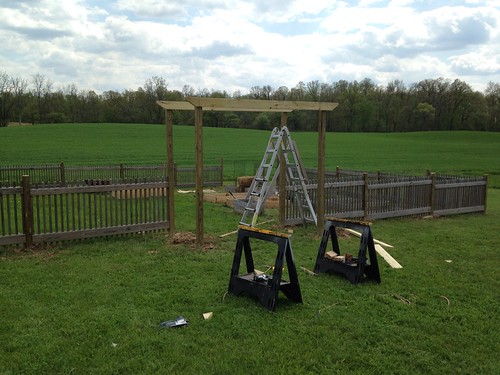
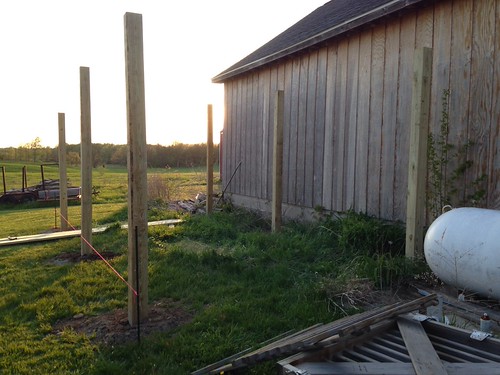
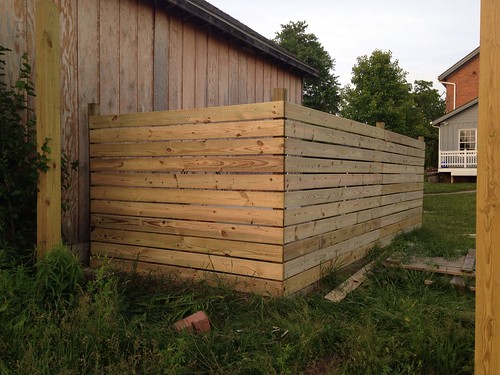
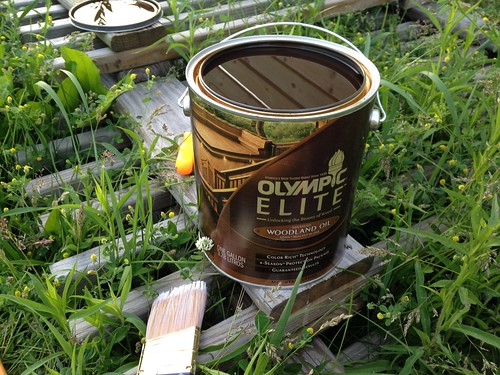
A couple of weeks ago my mom stood in the middle of my lawn, looked around—at the unfinished garden fence, unfinished garden arbor, unfinished raised beds, barely-started large pergola, and the unfinished fence around the propane tank—then she furrowed a brow and was like, “So… all of your outside projects count as one thing on your Five Project List then?” Ha. Ha. If you’re ever wondering where my smartass comes from, there you go… But she’s also right. Unless you count the entire 5.90 acres of land that occurs outside of the actual house as one project, then I think it’s safe to say I’ve blown my Five Project Rule all the way out of the water. But after that winter? I’m giving myself a little leeway to just build the heck out of some things. And since I’m in the middle of a million projects, I figure now might be a good time to start thinking about finishing at least a few of them before this twitch in my left eye becomes permanent. Like this one… Oh yeah, and this one… And this one… The trick is, I’ve got a bunch of different woods going on here, and I need to make some decisions about how to keep them cohesive. For the beds in the garden, I used cedar for its naturally bug and rot resistant properties. The salvaged fence, however, is probably a pressure-treated (and unstained) pine… however it’s worn to a nice gray color. The new pressure-treated posts for the arbor, pergola, and propane fence are, of course, a different color entirely. Because why not. I don’t know what the hell I’m going to do with the garden fence, but I figured everything on this side of the yard could use a nice coat of stain. Now, most of the time when people reach out and want me to test out a product for them, it’s like “Oh, hey, do you want to try out this new furniture polish?” And I’m like, “Um… maybe you haven’t been reading my website for the last three months, but my entire life is covered in freaking sawdust and garden soil… and I don’t clean.” So I was really surprised when Olympic Paints reached out to me a couple of weeks ago and wanted to know if I had any outdoor projects going on that I could test out some of the Olympic ELITE WOODLAND OIL stain on. (And while this is SUPER exciting, I’m not capitalizing the name for effect… that’s just how it’s spelled.) Try out a new product at the exact time I’m working on projects that need said product? Oh, Olympic Paints, DO I EVER. (That one was capitalized for effect.) And, actually, this turned out to be a really good thing for me because I have been understandably gun-shy about picking stain colors ever since the Great Maroon Beam Debacle of 2010. (For those of you who weren’t reading about the bad decisions I was making four years ago, it wasn’t pretty. And required buying a hand-planer and planning down all the wood. It still pisses me off, even though I don’t even live in that house anymore.) The big lesson I learned from that was NO SOLID STAINS on anything that I still want to look like wood. Here’s where Woodland Oil falls in the scheme of things:
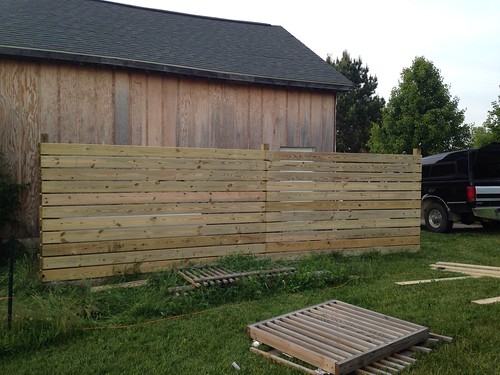
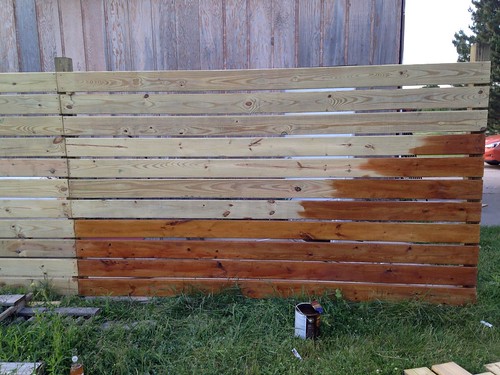
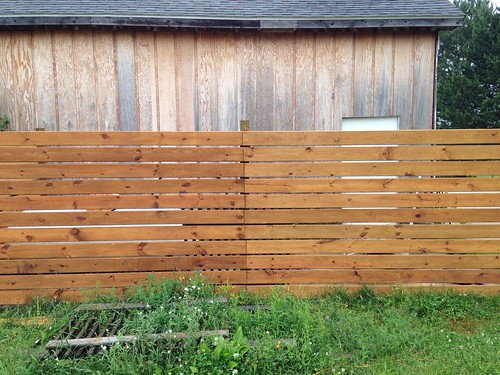
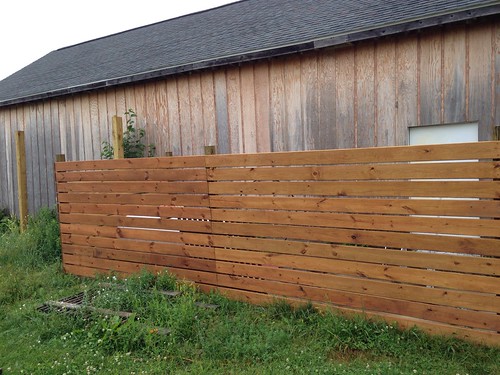
Word on the street is that this Olympic Elite Woodland Oil is all about enhancing the beauty of wood though, not covering it up with an ugly, solid maroon color. Which seemed like a much, much better idea than, you know, the last time. My biggest concern was choosing the color… I basically just wanted something to look like a deep, rich wood, without being too dark or too orange. I decided to give the cedar color a try, even though I’ve seen cedar stain that is basically the wood equivalent of a bad spray tan. The nice thing for a girl who has a million unfinished projects to tackle is that this is a one-coat stain plus sealant. Just one swipe of the paintbush. That’s extremely doable, and actually looks really good. (Took me two evenings after work to get this much done, so one side is still slightly darker than the other.) This is the rich color I was looking for, and I’m hoping it will look good against the eventual barn-red of the wall behind it. And you can still tell that it’s actual wood! Very exciting. It also makes the boards of the fence look more cohesive and finished (so that’s one thing in my life that can be said for…) I love the fact that it’s a one-and-done kind of project, and that the level of color/stain was perfect. Of course the real test of an outdoor wood-stain around here is how it holds up to the sun, rain, snow, hail, and other insanity that makes up Michigan weather, so I’ll check back in on this one in a few months. And probably again next Spring. I really appreciate a company that stands behind their product though and Olympic guarantees satisfaction with the application and performance properties of the stain (when you follow the directions, of course) or they’ll replace the product or give you your money back. So that’s awesome. It’s available exclusively at Lowe’s, which suits me just fine because I spend half of my time there anyway. In the next couple of weeks as I finish up the arbor and pergola, I’ll likely stain them the same color. I’m not sure about the weathered garden fence yet… I kind of like that one the way it is. (Also, thanks to Olympic Paint, who sponsored this post about all of my unfinished projects and bad decisions, and also provided the stain so that I could check at least one thing off my list. Don’t worry everyone, they didn’t tell me to say nice things about them… you’d know if they tried because then I definitely wouldn’t have said nice things about them. I’m contrary like that.)
The secret to lose weight is not only focusing on what to eat but also about caring what to drink. Maybe popular energy drinks, fruit juices, and soft drinks are loaded with carbohydrates and added sugars that can destroy your weight loss plan.
Best drinks to lose weight fast. (VKOOL)
If you want to lose some extra pounds, then maybe you already know that the best way to do is combining exercising with a healthy, nutritious, and balanced diet plan. Nevertheless, there are some drinks that can speed up the fat burning process and help to lose weight faster than you could in normal, and here you will find 13 out of the best drinks to lose weight that you should integrate into your daily diet if you want to get fit fast without using any supplements, drugs, or pills which can lead to dangerous side effects. 13 Best Drinks To Lose Weight Ever: 1. Coconut Water: The first out of drinks to lose weight I want to show you is coconut water – a tasty drink that many people love, especially in summer. Coconut water contains more electrolytes than most energy drinks and fruit juices without artificial flavorings plus and extra sugar. This juice can help to speed up your metabolism naturally and give you more energy. Thus, you can stay strong and energetic throughout the day while still can lose weight faster. 2. Yogurt Based Smoothies: This drink is recommended not only because the thickness of the smoothie kills your appetite but also because yogurt is loaded with calcium. Many researchers discovered that you can lose 81% more belly fat and 61% fat if you add yogurt to your daily diet because the calcium yogurt contains can help you burn fat and also limit the amount of fat that your body produces. Try to add Greek Yogurt to your smoothies, as well as some whey protein and fruits to make your smoothies more powerful for weight loss!
Scott DeLong. Dong Nguyen. Amanda Hocking. All those people found a way to create something and turn it into $1 million or more quickly.
Dong Nguyen created "Flappy Bird" last spring and claims he organically grew it to the top spot in the App Store. While "Flappy Bird" was at the top, Nguyen told The Verge's Ellis Hamburger it was generating $50,000 a day. After about a month, Nguyen removed the app from the App Store and Google Play because he felt his game was "too addicting." (Photo: STR/AFP/Getty Images)
Inspired by their stories, we found 11 unusual ways to make a relatively quick million online. Sell 477,000 apps in the App Store or 714,000 self-published books on the Kindle. Either could be the path to riches. Launch a one-person blog, master Facebook's algorithm, and make multiple millions in eight months. Average payment from Google ads: $2 per thousand views ($1 for each ad on the page). Million-dollar math: If a publisher generates 41,650,000 pageviews per month, they can generate about $83,000, or $1 million per year. Who did it: ViralNova founder Scott DeLong was able to launch his site and get it to 200 million monthly pageviews just eight months later. DeLong uses remnant ads (cheap ads like Google AdSense). There are two ads on every page. ViralNova's AdSense rate might be $2 per thousand views, $1 for each ad on the page, which would earn Delong $400,000 every month he hits 200 million pageviews. DeLong told Business Insider's Steve Kovach last January that he was indeed making six figures a month. That means his annual revenue run rate is between $1.2 million and $4.8 million a year, assuming ViralNova's traffic stays high. Be an UberX driver in NYC for 10 years. Median income of an UberX driver in NYC: $90,000 Amount drivers keep per ride: 80% Million-dollar math: According to Uber, the median wage for an UberX driver working at least 40 hours a week in New York City is $90,766 a year and $74,191 a year in San Francisco. That means 10 years of work in NYC could earn UberX drivers $1 million. It'd take 13.5 years in San Francisco. That's without the cost of owning an operating a car built in, however. Who did it: n/a; Uber the company is only a few years old. ... or a Lyft driver for life. It will take you twice as long to make a million dollars as UberX, according to Glassdoor reviews. Hourly Rate: $22.20, according to four driver responses on Glassdoor. A Lyft driver also told Business Insider's Megan Rose Dickey that he makes $800 a week, working five days a week. That's about $42,000 a year. Amount drivers keep per ride: 80%. Lyft keeps 20%, just like Uber, unless it's during "prime (busy) time" on the app, in which case the drivers keep it all. Million-dollar math: Assuming drivers work 40 hours a week, they'd have to work 21 or 22 years to make $1 million. Who did it: n/a Dog-sit for 6,667 pups on DogVacay. Average amount made per dogsitting: According to DogVacay, the average host could expect to make about $150 for a five-day Vacay (the average length for a first-time booking). That's after the 15% cut DogVacay takes per booking. The average payment varies from city to city, however. You keep: 100% of that. Million-dollar math: $150 x 6,667 dogsits = $1,000,000. Who did it: n/a Create a frustrating, viral app like 'Flappy Bird' and keep it in the App Store for at least 20 days. Payment from mobile ads: At its peak, "Flappy Bird" creator Dong Nguyen says he was making $50,000 a day on his free app by running a tiny mobile ad banner at the top of the game. Million-dollar math: $50,000 per day x 20 days = $1,000,000. Who did it: Dong Nguyen created "Flappy Bird" last spring and claims he organically grew it to the top spot in the App Store. While "Flappy Bird" was at the top, Nguyen told The Verge's Ellis Hamburger it was generating $50,000 a day. After about a month, Nguyen removed the app from the App Store and Google Play because he felt his game was "too addicting." Sell 714,286 self-published books on a Kindle. Average cost of a book sold: $2 You keep: 70% Million-dollar math: For every $2 book sold, you keep $1.40. $1.40 x 714,286 books = $1,000,000.40 Who did it: 29-year old Amanda Hocking was the best-selling "indie" writer on the Kindle store a few years ago. She was selling about 100,000 copies a month at $1 to $3 a pop, which set her on track to pocket a few million dollars.
Read the full articleby Alyson Shontell from Business Insider.


 Sau biết bao lời
đồn đãi là Đức và Mỹ sẽ bí mật thỏa hiệp huề
để cùng dẫn nhau vào vòng 16, hai đội banh không đồng
sức này đã chiến đấu hết sức quyết liệt.
Sau biết bao lời
đồn đãi là Đức và Mỹ sẽ bí mật thỏa hiệp huề
để cùng dẫn nhau vào vòng 16, hai đội banh không đồng
sức này đã chiến đấu hết sức quyết liệt.